| Manufacturing geography | Production is concentrated mainly in China's coastal manufacturing provinces, including Guangdong, Zhejiang, Jiangsu, Shandong and nearby industrial areas. | Coastal clusters generally provide better access to ingredient suppliers, packaging producers, ports, laboratories and logistics services. | Confirm the factory's registered address, production address and export-port arrangements. |
| Supplier structure | The sector includes dedicated pet-food factories, diversified food manufacturers, contract manufacturers and trading companies that outsource production. | A trading company may offer sourcing flexibility, while a direct factory usually provides clearer control over production and quality records. | Request the manufacturing license, factory photos, production-line details and a direct factory audit. |
| Main product formats | Common cat-treat categories include freeze-dried meat, dehydrated meat, wet treats, canned or pouch products, dental treats, soft snacks and functional treats. | Each format requires different equipment, moisture control, packaging and shelf-life validation. | Review the product specification, moisture level, water activity, storage conditions and shelf-life test. |
| Raw-material sourcing | Manufacturers commonly source poultry, fish, meat, animal by-products, starches, plant ingredients, oils and functional additives through domestic and international supply chains. | Ingredient origin and batch consistency can directly affect palatability, nutritional quality and regulatory acceptance. | Check approved-supplier lists, certificates of analysis, traceability records and allergen controls. |
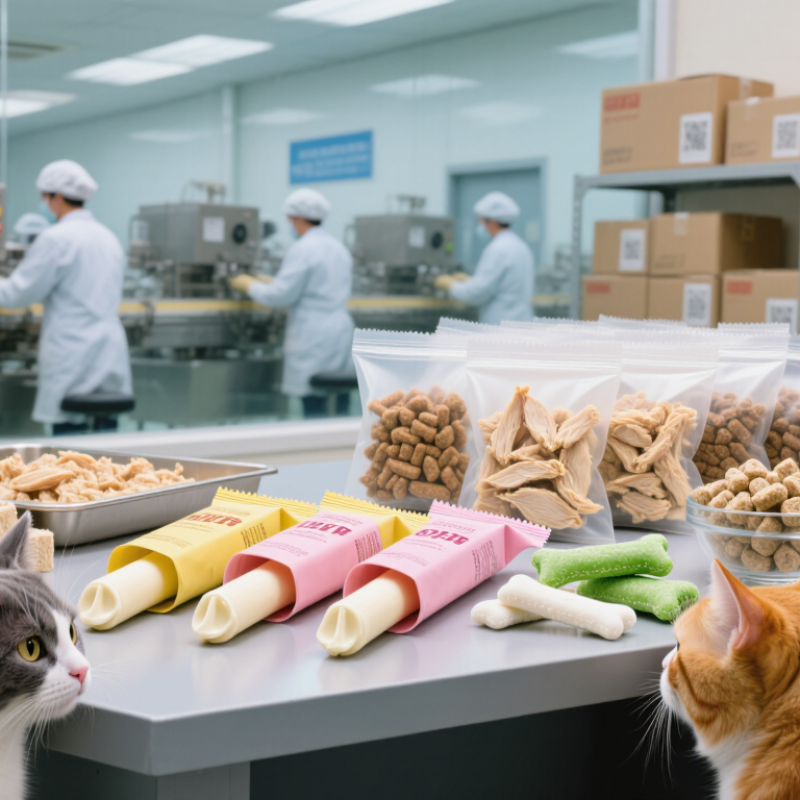
| Production process | Typical operations include ingredient inspection, formulation, cooking or drying, shaping, filling, sealing, metal detection, packaging and finished-product release. | Process control is especially important for high-moisture products and animal-protein treats. | Ask for process-flow diagrams, critical-control-point records and batch-release procedures. |
| Private-label capability | Many manufacturers support private-label orders involving custom formulas, packaging artwork, product sizes and minimum order quantities. | Private-label production can shorten product-development time but may require higher minimum volumes for customized formulas or packaging. | Confirm minimum order quantity, sample policy, formula ownership, tooling costs and lead time. |
| Quality-management systems | More established factories commonly use documented quality systems, sanitation procedures, supplier approval, in-process inspections and finished-product testing. | Documented systems reduce the risk of contamination, labeling errors, inconsistent texture and batch variation. | Review audit reports, sanitation logs, corrective-action records and product-testing results. |
| Food-safety controls | Controls typically address microbiological hazards, foreign materials, chemical residues, mycotoxins, oxidation and excessive moisture. | The required test panel depends on the recipe, processing method and destination market. | Request recent laboratory reports for microbiology, heavy metals, pesticide residues and other relevant risks. |
| Domestic compliance | Manufacturers operating in China must follow applicable Chinese feed and pet-food administration requirements, including rules covering production, labeling and product management. | A compliant domestic production setup is a basic prerequisite, but it does not automatically guarantee compliance in another country. | Check current production qualifications, product labels and applicable Chinese regulatory filings. |
| Export compliance | Export requirements vary by destination and may involve importer registration, approved establishments, ingredient restrictions, certificates, labeling rules and testing requirements. | A factory experienced in one export market may still need additional documentation for a different region. | Match the supplier's documents with the latest requirements of the destination authority and importer. |
| Packaging technology | Common packaging solutions include pouches, sachets, trays, cans and resealable bags, with options such as oxygen barriers, nitrogen flushing and moisture protection. | Packaging selection affects oxidation, texture, shelf life, shipping durability and retail presentation. | Review packaging-material specifications, seal-strength tests, migration compliance and storage trials. |
| Order economics | Pricing is influenced by protein type, ingredient grade, processing method, packaging format, order quantity, testing requirements and shipping terms. | The lowest quoted price may not include formula development, testing, artwork, molds, inspection or export documentation. | Compare complete quotations using the same formula, pack size, Incoterm, test scope and delivery schedule. |
| Product development | Factories with in-house technical teams may provide formulation adjustment, palatability trials, texture development, packaging trials and stability testing. | Technical support is valuable when launching functional treats or products with specific nutritional and sensory targets. | Ask for development timelines, prototype records, testing methods and ownership of the final formula. |
| Traceability and recalls | Mature operations link incoming ingredients, production batches, packaging materials and finished goods through documented batch codes. | Effective traceability allows faster investigation and targeted recalls if a quality issue occurs. | Request a sample traceability exercise from finished product back to raw-material batches. |
| How to identify a strong manufacturer | The strongest candidates usually combine valid qualifications, stable production capacity, transparent sourcing, reliable testing, export experience and consistent batch performance. | Supplier selection should be based on verified capabilities rather than catalog size, online listings or a single low quotation. | Use samples, factory audits, third-party inspections, reference checks and a controlled trial order. |